Challenges of Online Education: Solutions for RTOs and Training Providers

Online education has transformed how we learn and teach. From vocational online learning to professional development programs, digital platforms have opened doors for thousands of adult learners who need flexible, accessible training options.
But let’s be honest—online education isn’t without its problems. If you’re an RTO, training provider, or educator delivering courses through an LMS, you’ve probably encountered some of these challenges of online education firsthand: low completion rates, disengaged learners, technical headaches, and the constant question of how to teach practical skills remotely.
The good news? These challenges aren’t insurmountable. With thoughtful education design, proper support systems, and smart e-learning development strategies, you can create online courses that truly work.
In this guide, we’ll walk through the most common challenges of online education and, more importantly, practical solutions you can implement right away.
Why Understanding the Challenges of Online Education Matters
Before diving into solutions, it’s worth understanding why these challenges exist. Online education requires a fundamentally different approach than traditional classroom training. Adult education principles still apply—relevance, practical application, respect for experience—but the delivery method changes everything.
For RTOs working in the VET sector, the stakes are even higher. You’re not just delivering information; you’re building competencies that meet strict compliance standards. Your learners need real skills they can apply immediately in their workplaces.
When online course development doesn’t account for these unique challenges, the results are predictable: frustrated learners, overwhelmed trainers, poor outcomes, and resources wasted on courses that don’t deliver.
Let’s tackle each major challenge head-on.

Challenge 1: Lack of Engagement and Motivation
The Problem
This is perhaps the biggest challenge of online education. Learners start courses with enthusiasm but gradually disengage. They stop logging in, fall behind on modules, and eventually drop out entirely. Completion rates for online courses are notoriously lower than face-to-face training.
Why does this happen? Several reasons:
- Content feels like reading a textbook with a “Next” button
- No social interaction or peer connection
- Lack of immediate accountability
- No visible progress or sense of achievement
- Life and work demands take priority
The Solutions
Interactive digital design: Move beyond static content. Use scenarios where learners make decisions, incorporate knowledge checks with meaningful feedback, and add drag-and-drop activities that require active participation.
Progress tracking: Make achievement visible. Show learners exactly where they are in their journey with progress bars, completion percentages, and milestone celebrations.
Community features: Create discussion forums, group activities, or virtual study sessions. Adult learners benefit enormously from peer interaction and shared experiences.
Regular touchpoints: Schedule weekly check-ins, send encouraging messages at key points, and recognise achievements publicly (when appropriate).
Chunked content: Break learning into manageable pieces. Micro-learning modules that take 10-15 minutes are far less intimidating than hour-long sessions.
Challenge 2: Technical Barriers and Digital Literacy
The Problem
Not everyone enters vocational online learning with the same level of tech comfort. Some learners struggle with basic LMS navigation, don’t understand how to submit assignments, or experience technical issues they can’t troubleshoot.
This creates unnecessary frustration and can cause capable learners to give up before they even engage with your actual course content.
The Solutions
User-friendly LMS design: Choose platforms with intuitive interfaces. If your current LMS is clunky, optimise it with better navigation, clearer labelling, and streamlined processes.
Comprehensive onboarding: Create a short “how to use this platform” orientation module. Show learners exactly how to navigate, submit work, access resources, and get help.
Clear instructions everywhere: Never assume learners know what to do. Use explicit directions: “Click the blue ‘Submit’ button below” rather than just “Submit your work.”
Accessible tech support: Provide multiple ways to get help—email, phone, chat, video tutorials. Respond quickly to technical questions, especially in the first few weeks.
Mobile-friendly design: Many adult learners access courses on phones or tablets during commutes or breaks. Ensure your e-learning development accounts for smaller screens and touch navigation.
Alternative formats: Offer content in multiple formats when possible—text, video, audio—so learners can choose what works best for their situation.
Challenge 3: Maintaining Assessment Integrity
The Problem
One of the trickiest challenges of online education is ensuring assessment validity and integrity. How do you know learners truly understand the material and haven’t just googled answers? For RTOs, this isn’t just about grades—it’s about competency validation that must meet regulatory standards.
The Solutions
Authentic assessment tasks: Instead of multiple-choice tests, design assessments that require application. Ask learners to create documents they’d actually use on the job, solve realistic problems, or analyzeanalyse case studies.
Varied assessment methods: Use a mix of approaches—written responses, video submissions, practical demonstrations, project-based tasks, and portfolio evidence.
Workplace integration: For vocational online learning, incorporate on-the-job observations and supervisor verification. Blend online theory with workplace practice.
Oral assessments: Schedule video calls where learners explain their thinking, defend decisions, or talk through processes. This reveals depth of understanding that written tests might miss.
Randomised question banks: If using quizzes, draw from larger pools so each learner sees different questions, reducing the value of sharing answers.
Open-book philosophy: Design questions where having resources available doesn’t matter—focus on application, analysis, and synthesis rather than recall.
Challenge 4: Limited Practical Skills Development
The Problem
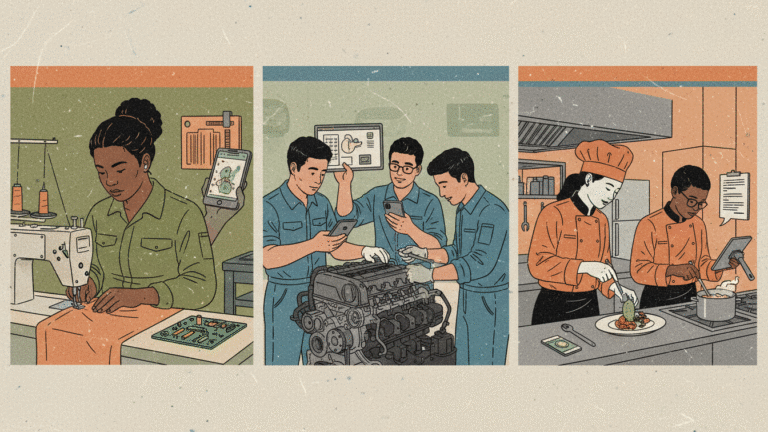
This is the elephant in the room for vocational online learning. How do you teach welding, hairdressing, machinery operation, or food preparation through a screen? Practical skills are central to VET, and online delivery seems fundamentally incompatible with hands-on learning.
The Solutions
Blended learning models: Combine online theory with face-to-face practical sessions. Learners complete knowledge components at their own pace, then attend scheduled workshops for hands-on practice. This actually optimises learning by ensuring everyone arrives at practical sessions with foundational knowledge.
High-quality demonstration videos: Show procedures from multiple angles with clear audio explaining each step. Break complex skills into smaller components that learners can review repeatedly.
Simulations and virtual practice: Depending on your field, software simulations can provide risk-free practice environments. While not replacing hands-on work, they build confidence and foundational understanding.
Workplace-based learning: Partner with employers to provide supervised practice in actual work environments. Your online course becomes the knowledge foundation while real workplaces provide the practical context.
Photo and video evidence: Ask learners to document their practical work through photos or videos, demonstrating techniques and explaining their process. This works particularly well for fields like cookery, construction, or beauty services.
Challenge 5: Communication and Feedback Gaps
The Problem
In face-to-face training, communication is immediate and natural. Online, it becomes fragmented. Emails pile up, questions go unanswered for days, tone gets misinterpreted in text, and learners feel abandoned. For adult education, where learners often need quick clarification to progress, these gaps are particularly problematic.
The Solutions
Clear communication channels: Establish exactly how and when learners should contact you. “For urgent questions, email me. For general discussion, use the forum. For technical issues, contact support@…”
Response time commitments: Set expectations—”I’ll respond to emails within 24 hours on weekdays”—and stick to them. Consistency builds trust.
Regular feedback on work: Don’t just grade assignments; provide meaningful feedback that helps learners improve. Highlight what they did well and give specific guidance on what to develop.
Office hours: Schedule regular times when learners can drop into a video call for quick questions or discussions. Even if attendance is low, knowing the option exists provides reassurance.
Proactive outreach: Don’t wait for learners to ask for help. If someone hasn’t logged in for a week or hasn’t submitted expected work, reach out. A simple “How are you going? Do you need any support?” can make all the difference.
Video messages: Sometimes a 30-second video explaining something is clearer than a paragraph of text. Use tools like Loom for quick, personal communication.
Challenge 6: Time Management and Self-Discipline
The Problem
Adult learners juggle work, family, and other responsibilities. Self-paced online learning sounds great in theory—”study whenever it suits you!”—but in practice, life always seems to get in the way. Without set class times creating external structure, procrastination creeps in.
The Solutions
Structured schedules: While offering flexibility, provide a recommended weekly schedule. “This week, complete Module 3 and submit Assignment 2 by Friday.” Clear milestones help learners plan.
Calendar integration: Provide due dates that sync with digital calendars. Reminders on phones help learners remember commitments.
Realistic pacing: Design courses with adult learners’ constraints in mind. If your target audience works full-time, don’t expect them to complete 10 hours of coursework weekly.
Chunked learning: Break content into 15-20 minute segments. It’s easier to find a short block of time than dedicate an entire evening to study.
Accountability mechanisms: Peer learning groups, study buddies, or regular check-ins with trainers create helpful external accountability.
Early momentum: Front-load engagement. The first two weeks are critical. Simpler, more engaging content early builds momentum that carries through harder material later.
Challenge 7: Technology Access and Infrastructure
The Problem
We often assume everyone has reliable high-speed internet, modern devices, and unlimited data. That’s not reality. Some learners access courses on old smartphones with limited data plans. Others live in regional areas with patchy connectivity. These aren’t minor inconveniences—they’re genuine barriers to education.
The Solutions
Mobile-first design: Design for the smallest screen and most limited bandwidth first. Everything else becomes easier from there.
Downloadable content: Allow learners to download modules, videos, or resources to access offline. They can study during commutes or in areas without connectivity.
Low-bandwidth alternatives: Offer text versions of video content. Compress images appropriately. Avoid auto-playing videos that consume data.
Device flexibility: Ensure your online course development works across devices and browsers. Test on both iOS and Android, desktop and mobile.
Alternative access options: For learners truly without suitable technology, consider partnering with libraries, community centres, or employers to provide access points.
Transparent requirements: Clearly state technical requirements upfront. Tell learners what devices, browsers, and internet speeds work best so they can plan accordingly.

Challenge 8: Trainer Readiness and Capability
The Problem
Many excellent classroom trainers struggle with online delivery. It requires different skills—digital design capability, comfort with technology, understanding of asynchronous communication, ability to engage learners you rarely see face-to-face. Simply moving classroom content online rarely works well.
The Solutions
Professional development for trainers: Invest in upskilling your team. Online teaching is a specific skill set that can be learned and improved.
Instructional design support: Not every trainer needs to be an e-learning development expert. Partner them with instructional designers who understand education design principles and can help structure content effectively.
Templates and frameworks: Provide trainers with proven structures they can adapt rather than starting from scratch each time.
Peer mentoring: Connect trainers who are new to online delivery with experienced colleagues. Learning from those who’ve solved similar problems accelerates development.
Time for quality development: Recognise that creating good online content takes time. Don’t expect trainers to develop courses while maintaining full teaching loads.
Ongoing support: Digital education evolves constantly. Provide continuous learning opportunities about new tools, techniques, and approaches.
Challenge 9: Compliance and Quality Standards
The Problem
For RTOs, compliance with ASQA and VET Quality Framework requirements adds complexity to online delivery. You must demonstrate equivalence to classroom training, collect appropriate evidence, maintain assessment validity, and document everything thoroughly. The challenges of online education compound when regulatory oversight is involved.
The Solutions
Mapping to standards from the start: Build compliance into your online course development process from day one. Map learning activities and assessments to specific units of competency.
Clear evidence collection: Design assessment tasks that generate evidence meeting validity, sufficiency, currency, and authenticity requirements. Make submission processes straightforward.
Documentation systems: Use your LMS to automatically track participation, completion, and assessment outcomes. Good systems make audits less stressful.
Regular validation: Conduct ongoing validation of assessment resources and practices, just as you would with face-to-face training.
Trainer qualifications: Ensure trainers delivering online have appropriate TAE qualifications and relevant vocational competency.
Quality review cycles: Regularly review course performance data—completion rates, assessment results, learner feedback—and make improvements based on evidence.
Making Online Education Work: The Path Forward
The challenges of online education are real, but they’re not insurmountable. What separates successful online training from ineffective programs is usually not the technology—it’s the thoughtfulness of the design and the quality of support provided.
Great vocational online learning doesn’t happen by accident. It requires:
- Learner-centred design: Always ask “what does the learner need?” rather than “what’s easiest for us?”
- Quality content development: Invest time in proper e-learning development with engaging, interactive elements
- Robust support systems: For both learners and trainers
- Continuous improvement: Regular evaluation and willingness to adapt based on feedback
- Realistic expectations: Understanding that online delivery has unique strengths and limitations
For RTOs and training providers, addressing these challenges isn’t optional—it’s essential to delivering quality adult education that meets standards and produces competent graduates.
Conclusion
Online education has opened incredible opportunities for flexible, accessible professional development and vocational training. But delivering quality online courses requires understanding and addressing the unique challenges of online education.
From engagement and technical barriers to practical skills development and compliance requirements, each challenge has practical solutions. The key is approaching online course development thoughtfully, prioritising learner experience, supporting your trainers, and being willing to continuously improve.
Start by identifying which challenges are most significant in your context. Focus on solving one or two well rather than tackling everything simultaneously. Measure your results, gather feedback, and refine your approach.
With good education design and proper support, online learning can be just as effective—and in some ways more effective—than traditional face-to-face training. The flexibility it offers adult learners while maintaining quality outcomes is worth the effort invested in getting it right.
Frequently Asked Questions
Q: What are the main challenges of online education for vocational training?
A: The biggest challenges include maintaining learner engagement, developing practical hands-on skills remotely, ensuring assessment integrity, overcoming technical barriers for learners with limited digital literacy, and meeting compliance requirements for RTOs. Successful vocational online learning addresses these through blended delivery models, interactive digital design, varied assessment approaches, strong support systems, and careful compliance planning from the outset.
Q: How can RTOs improve completion rates in online courses?
A: Improving completion rates requires multiple strategies: create engaging, interactive content rather than passive reading; provide clear structure with manageable milestones; establish regular communication and proactive support; make progress visible through tracking features; build community through forums or group activities; and ensure early momentum in the first 1-2 weeks when dropout risk is highest. Adult education research shows that support and engagement, not just content quality, drive completion.
Q: Can online learning be as effective as face-to-face for adult learners?
A: Yes, when properly designed. Research shows online education can be equally or more effective than traditional delivery, particularly for adult learners who value flexibility. The key is applying adult learning principles—practical relevance, self-direction, immediate application—through appropriate education design. For skills requiring physical practice, blended models combining online theory with face-to-face practical sessions often produce the best outcomes. Pure online works well for knowledge and decision-making skills.
Q: How do you teach practical skills in online vocational courses?
A: Practical skills development online uses several approaches: high-quality demonstration videos showing techniques from multiple angles; workplace-based learning where learners practice in real employment settings with supervision; blended delivery combining online theory with scheduled hands-on workshops; simulations and virtual environments for risk-free practice; and evidence collection through photos or videos of learners performing tasks. Most effective vocational online learning doesn’t try to do everything online—it strategically combines digital and physical learning experiences.
Q: What technology do learners need for online education to work effectively?
A: Basic requirements include a device (computer, tablet, or smartphone), internet connectivity, and a modern web browser. However, e-learning development should account for varying access levels. Design for mobile devices and limited bandwidth; offer downloadable content for offline access; provide text alternatives to videos; and ensure compatibility across different browsers and operating systems. Good online course development works on the technology learners actually have, not ideal conditions. For learners with significant technology barriers, partner with libraries, community centres, or employers to provide access points.