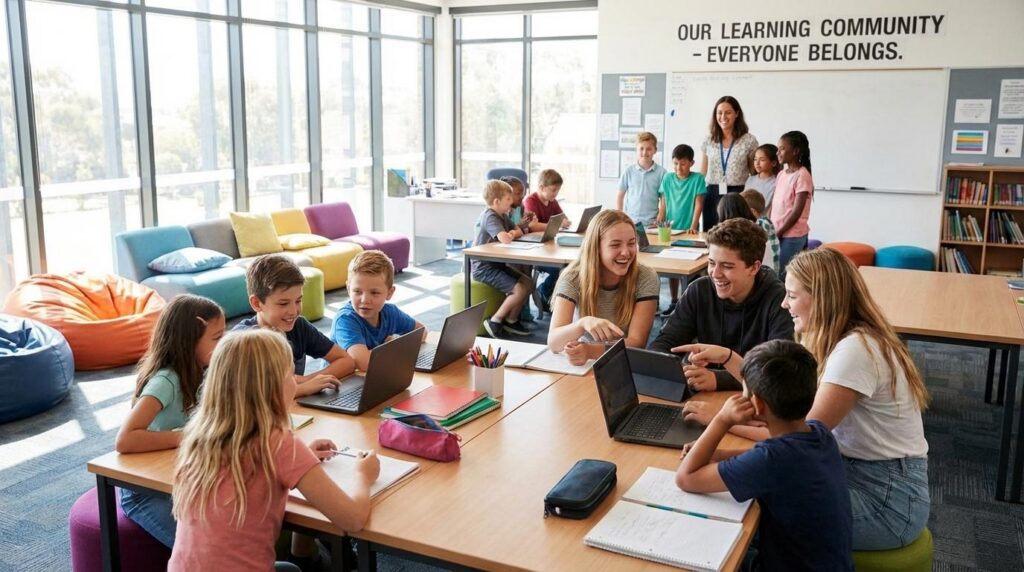
A safe learning environment is a setting where students feel physically protected, emotionally supported, socially included, and intellectually secure enough to engage in learning without fear of harm, humiliation, bias, or misinformation. This foundational educational principle extends beyond physical classroom walls to encompass emotional well-being, social dynamics, and digital safety as learning environments incorporate technology, online platforms, and artificial intelligence tools.
Modern classrooms blend physical and digital spaces. Students engage with AI tutors, submit work through learning management systems, and access information through digital tools. Creating a safe learning environment requires addressing traditional safety dimensions while expanding frameworks to include digital conduct, AI-generated content risks, algorithmic bias and student data protection. This article provides a comprehensive framework for understanding and building safe learning environments that prepare students for success in both traditional and technology-enhanced educational contexts.
What Is a Safe Learning Environment?
Safe learning environments encompass multiple interconnected dimensions that together create conditions where all students can learn effectively without physical, emotional, social, or intellectual barriers.
Physical Safety
Physical safety forms the foundation of any learning environment. Students cannot focus on learning when concerned about immediate physical threats or unsafe conditions.
Physical safety includes secure infrastructure with well-maintained facilities, functioning locks and access controls, proper lighting, and hazard-free spaces. Emergency preparedness procedures ensure students and staff know evacuation protocols, lockdown procedures, and response plans for various emergency scenarios.
Clean, well-maintained facilities signal institutional care and prevent health hazards. Adequate supervision throughout campus, including hallways, playgrounds, cafeterias, and transition spaces, prevents incidents and provides students with visible adult presence.
Violence prevention through clear behavioural policies, anti-bullying programs, conflict resolution training, and zero-tolerance policies for weapons or threatening behaviour creates environments where students feel protected. Staff training in recognising warning signs, de-escalation techniques, and appropriate intervention strengthens physical safety infrastructure.
Examples include secure campus design with controlled entry points, visible security personnel where appropriate, anonymous reporting systems for safety concerns, and regular safety drills ensuring preparedness.
Emotional and Psychological Safety
Emotional safety enables students to take intellectual risks, ask questions, make mistakes, and engage authentically in learning without fear of humiliation, ridicule, or emotional harm.
Freedom from bullying, harassment, and intimidation creates baseline psychological safety. Respectful communication norms established by educators and modeled consistently teach students appropriate interaction patterns. Trauma-informed practices recognise that many students carry experiences affecting their capacity to engage and require sensitive, understanding approaches.
Encouragement of student voice and participation signals that contributions are valued, questions are welcome, and diverse perspectives enrich learning. Growth mindset culture frames mistakes as learning opportunities rather than failures, reducing perfectionism and fear of participation.
Mental health supports including school counselors, wellness programs, and appropriate referral systems acknowledge that emotional well-being directly impacts learning capacity. Teacher-student trust built through consistency, fairness, and genuine care creates relationships where students feel known and supported.
Psychological safety functions as prerequisite for deeper learning, students cannot engage in complex problem-solving, creative thinking, or vulnerable discussion when anxious about emotional safety.
Social Inclusion and Belonging
Social safety ensures all students feel welcomed, represented, and valued regardless of background, identity, ability, or circumstance.
Equity and inclusion practices actively address barriers preventing full participation. Cultural responsiveness in curriculum content, teaching approaches, and classroom materials reflects and honors student diversity. Representation matters—students see themselves in examples, stories, and imagery throughout learning materials.
Zero tolerance for discrimination based on race, ethnicity, gender, religion, sexual orientation, disability, or socioeconomic status creates clear expectations about acceptable behaviour. Inclusive classroom policies accommodate different learning needs, communication styles, and cultural practices.
Diversity strengthens learning environments by exposing students to varied perspectives, challenging assumptions, and building empathy. Belonging improves retention, academic performance, and long-term educational outcomes—students persist when they feel genuinely part of their learning community.
Clear Expectations and Structured Learning
Predictability and transparency contribute significantly to learning environment safety by reducing anxiety and creating fair conditions.
Defined rules and behavioural expectations provide clear boundaries. When students understand what’s expected and consequences are consistent and proportional, they feel secure within known structures. Predictable classroom routines reduce cognitive load, allowing students to focus energy on learning rather than navigating uncertainty.
Transparent grading systems and assessment criteria ensure students understand how performance is evaluated. Academic integrity standards clearly defining plagiarism, proper attribution, and honest work protect both students and academic rigor.
Behavioural accountability applied fairly and consistently demonstrates that rules serve everyone equally. When consequences are predictable and proportional, students experience justice rather than arbitrary authority.
Why Is a Safe Learning Environment Important?
The importance of safe learning environments extends beyond surface-level comfort to fundamental conditions enabling learning itself.
Safe environments improve academic performance because students free from safety concerns can dedicate cognitive resources to learning rather than threat monitoring. Anxiety, fear, and insecurity consume working memory capacity needed for information processing, problem-solving, and critical thinking.
Reduced dropout rates correlate strongly with school safety. Students who feel unsafe physically, emotionally, or socially are more likely to disengage and eventually leave. Conversely, safe, supportive environments increase attendance, engagement, and persistence through challenges.
Enhanced cognitive engagement occurs when students feel secure enough to ask questions, take intellectual risks, propose ideas, and acknowledge confusion. Deep learning requires vulnerability—admitting what you don’t understand and struggling through difficult concepts—which only happens in psychologically safe contexts.
Resilience building emerges from safe environments that allow failure, provide supportive feedback, and encourage growth. Students develop the capacity to persist through difficulty when they know support exists and mistakes don’t result in humiliation or rejection.
Trust enables curiosity. When students trust their environment, they explore ideas more boldly, question more freely, and engage more authentically. This exploratory mindset drives learning depth beyond surface memorisation.
Long-term developmental benefits include stronger executive function, healthier social skills, better emotional regulation, and higher educational attainment. The safety students experience during educational years shapes lifelong approaches to learning, risk-taking, and collaboration.
How to Create a Safe Learning Environment (Traditional Framework)
Building safe learning environments requires intentional practices across multiple domains.
Establish Clear Behavioural Standards
Written codes of conduct articulate expected behaviours, prohibited actions, and consequences clearly. Standards should be developmentally appropriate, consistently communicated, and regularly reinforced.
Consistent enforcement ensures rules apply equally to all students. Inconsistency erodes trust and creates perceptions of unfairness that undermine safety. Restorative discipline approaches focus on repairing harm, understanding impact, and rebuilding relationships rather than purely punitive responses.
Train Educators in Inclusive Practices
Teachers require ongoing professional development in trauma-informed instruction recognising how adverse experiences affect learning and behaviour. Bias awareness training helps educators identify and interrupt implicit biases affecting expectations, discipline, and support allocation.
Classroom management training in positive behavioural interventions, de-escalation techniques, and proactive relationship-building strengthens educators’ capacity to maintain safe, productive environments.
Build Strong Teacher-Student Relationships
Regular feedback loops where students receive constructive guidance demonstrate investment in their success. Active listening by educators signals that student perspectives matter and concerns are taken seriously.
Respectful dialogue modeled by teachers establishes communication norms. When educators treat students with dignity, acknowledge emotions, and respond thoughtfully, students internalise these interaction patterns.
Encourage Student Voice and Participation
Safe discussion formats with clear participation norms enable diverse viewpoint sharing without fear of ridicule. Anonymous reporting tools allow students to raise safety concerns without social risk.
Collaborative projects build community through shared goals and interdependence. Student government, clubs, and leadership opportunities give students agency in shaping their environment.
Maintain Transparent Communication With Families
Policy clarity ensures families understand behavioural expectations, safety procedures, and available supports. Clear reporting channels allow families to raise concerns and receive timely responses.
Consistent updates about school safety initiatives, policy changes, and incident responses build trust between institutions and families.
The Digital Dimension of a Safe Learning Environment
Classrooms are no longer purely physical spaces. Students learn through digital platforms, interact via online tools, and increasingly engage with AI systems. Creating safe learning environments now requires addressing digital safety alongside traditional concerns.
Digital Safety and Online Conduct
Cyberbullying extends harassment beyond school grounds through social media, messaging apps, and online forums. Schools must address digital harassment even when it occurs outside the physical campus, as impacts affect on-campus learning.
Inappropriate content exposure through unfiltered internet access or peer sharing requires age-appropriate content filtering and digital citizenship education. Screen-time governance balances technology’s educational benefits against excessive use impacts on attention, sleep, and social development.
Digital conduct policies extending behavioural expectations to online spaces clarify that respect, kindness, and academic integrity apply regardless of medium.
AI-Generated Misinformation Risks
As AI tools become standard in education, students face new information reliability challenges. AI hallucinations—where systems confidently generate false information—create risks when students cannot distinguish accurate from fabricated content.
Fabricated citations that appear legitimate mislead students researching topics. Confident but inaccurate outputs delivered in authoritative tones may be trusted without verification. These risks escalate in academic settings where misinformation undermines knowledge acquisition and critical thinking development.
This isn’t technology fear, it’s governance recognition. Institutions must address AI accuracy risks through education, tool selection, and structured implementation rather than banning technology or ignoring challenges.
Bias in AI Systems
Algorithmic bias occurs when AI systems reflect biases present in training data or design decisions. Cultural skew in AI responses may center certain perspectives while marginalising others. Uneven representation means some student identities, experiences, or knowledge traditions are underrepresented or mischaracterised.
Reinforcement of stereotypes through biased AI outputs undermines inclusion efforts and harms students from marginalised communities. Schools committed to equitable learning environments must address AI bias as an inclusion and safety issue, not merely a technical concern.
Data Privacy and Student Protection
Student interactions with AI systems generate data—questions asked, knowledge gaps revealed, learning patterns displayed. Sensitive conversations in AI tutoring contexts might include personal struggles, family situations, or academic challenges.
Educational data privacy protections require careful consideration of who accesses student interaction logs, how data is stored and protected, and whether students and families understand data collection practices. Consent and transparency about AI tool data practices respect student privacy rights and build trust.
AI in Education:Risk or Responsibility?
The question isn’t whether AI belongs in education,it’s how institutions implement AI responsibly.
Unstructured AI deployment without guardrails creates unpredictable experiences. Open public AI tools like consumer chatbots weren’t designed for educational contexts and lack curriculum alignment, age-appropriate filtering, or institutional oversight. Absence of moderation exposes students to inappropriate content, misinformation, or interactions misaligned with educational values.
However, structured AI implementation offers genuine educational benefits when designed with safety and learning outcomes prioritised. Contained knowledge systems restrict AI responses to verified, curriculum-aligned content rather than open internet information. Curriculum-aligned design ensures AI interactions support rather than contradict instructional goals.
Human oversight maintains educator authority over learning experiences while leveraging AI’s scalability and availability. The distinction between reckless and responsible AI use lies in institutional design choices, governance frameworks, and commitment to student safety over technology novelty.
Framework for Building a Safe AI-Enhanced Learning Environment

Institutions can harness AI’s educational potential while protecting students through structured implementation frameworks.
1. Define Behavioural and Educational Boundaries
Before deploying AI tools, institutions must establish clear parameters: What topics can AI address? What subjects are restricted or require human educator involvement? What age-appropriate filtering applies? What constitutes appropriate versus inappropriate student-AI interaction?
Clear institutional guardrails protect students, guide AI tool configuration, and set expectations for acceptable use. Boundaries should be developmentally appropriate, culturally responsive, and aligned with institutional values.
2. Implement Contained AI Systems
Closed knowledge environments limit AI responses to institution-approved content rather than open web information. Curriculum alignment ensures AI knowledge bases reflect what educators teach. Restricted topic scope prevents AI from addressing sensitive subjects requiring human judgment, cultural competency, or emotional intelligence.
Moderated conversational flows guide interactions toward learning objectives while preventing drift into inappropriate territory. Structured conversational AI aligned to institutional standards, like systems designed specifically for educational deployment, provide the containment necessary for safe implementation.
3. Align AI With Curriculum Objectives
Lesson-specific integration means AI tools support particular learning goals rather than serving as general-purpose chatbots. Controlled prompts designed by educators guide student-AI interactions productively.
Teacher-configured knowledge domains allow instructors to customise AI knowledge boundaries for specific courses, units, or learning objectives. This ensures AI supplements human instruction coherently rather than introducing conflicting information or approaches.
4. Protect Student Data
Minimise data retention by collecting only information necessary for educational purposes. Transparent logging means students and families understand what data is collected, how it’s used, and who accesses it.
Institutional ownership of student interaction data prevents third-party exploitation or commercial use of educational information. Privacy protections appropriate for educational contexts differ significantly from consumer technology practices.
5. Monitor and Audit AI Interactions
Oversight dashboards provide administrators and educators visibility into how students use AI tools, what questions arise frequently, and whether interactions remain appropriate and productive.
Teacher review capabilities allow educators to examine student-AI conversations when concerns arise. Regular bias audits assess whether AI responses treat all students equitably or perpetuate stereotypes and exclusions.
6. Maintain Human Oversight
AI supports, never replaces, educators. Clear escalation pathways ensure complex questions, sensitive topics, or concerning interactions reach human educators rather than remaining AI-only interactions.
Accountability structures assign responsibility for AI tool selection, configuration, monitoring, and student protection. When problems arise, clear authority and responsibility lines enable swift, appropriate response.
This framework distinguishes responsible AI implementation from reckless deployment, positioning institutions as leaders in educational innovation rather than passive consumers of commercial technology.
Examples of a Safe Learning Environment in Modern Classrooms
Concrete examples illustrate safe learning environment principles in practice:
Inclusive Discussion Classroom: Elementary classroom with established discussion norms where students use sentence stems like “I respectfully disagree because…” and “Can you help me understand…” ensuring all voices are heard safely.
Restorative Discipline School: Middle school using restorative justice practices where behavioural incidents involve facilitated conversations focusing on harm repair, perspective-taking, and relationship rebuilding rather than solely punitive consequences.
Moderated Digital Discussion Board: High school utilising moderated online discussion platform where teachers review posts before publication, ensuring respectful dialogue and preventing cyberbullying while maintaining student voice.
Contained AI for Curriculum Support: University course using structured conversational AI trained on course materials to answer student questions 24/7, with clear boundaries about AI scope and human instructor availability for complex discussions.
Structured AI Tutoring: Training program implementing AI practice simulations within defined parameters where learners rehearse professional scenarios with AI personas designed for specific skill development under instructor oversight.
These examples demonstrate how traditional safety principles extend into digital and AI-enhanced learning contexts.
Common Mistakes Schools Make When Implementing AI
Understanding implementation pitfalls helps institutions avoid compromising student safety:
Deploying open AI tools without policy creates uncontrolled environments where students access unrestricted chatbots without guidance, boundaries, or monitoring.
Allowing unrestricted chatbots gives students access to AI trained on open internet data without educational filtering, curriculum alignment, or age-appropriate moderation.
Ignoring bias audits means institutions remain unaware whether AI tools treat all students equitably or perpetuate harmful stereotypes and exclusions.
Failing to train teachers leaves educators unprepared to guide students in appropriate AI use, unable to recognise concerns, and uncertain about their role in AI-enhanced learning.
No monitoring system eliminates oversight visibility, preventing identification of problems until significant harm occurs rather than enabling proactive intervention.
These mistakes reflect treating AI as consumer technology rather than educational infrastructure requiring thoughtful governance and institutional responsibility.
The Future of Safe Learning Environments

Safe learning environments will increasingly embrace hybrid physical-digital models requiring integrated safety frameworks addressing both dimensions simultaneously.
AI literacy as safety component means students develop critical evaluation skills, understanding AI capabilities and limitations, recognising when to question AI outputs, and knowing when human expertise is necessary. This literacy protects students in educational contexts and throughout life.
Governance-first EdTech adoption prioritises institutional control, student protection, and educational alignment over technology novelty. Rather than adopting every new tool, institutions evaluate whether technologies support learning goals while maintaining safety commitments.
Institutional containment over open experimentation reflects recognition that students’ educational environments require more structure and protection than adult consumer contexts. Responsible institutions partner with providers designing AI specifically for educational deployment rather than repurposing consumer technologies.
The evolution of safe learning environments continues—but core principles of protection, respect, inclusion, and appropriate structure remain constant even as implementation contexts change.
Frequently Asked Questions
What is the meaning of a safe learning environment?
A safe learning environment is a setting where students feel physically secure, emotionally supported, socially included, and intellectually protected from harm, bias, or misinformation. It encompasses traditional safety concerns plus modern digital and AI-related dimensions, creating conditions where all students can learn effectively without fear or barriers.
What are the five elements of a safe learning environment?
The five core elements are physical safety (secure facilities and violence prevention), emotional safety (psychological well-being and freedom from bullying), social inclusion (belonging and equity for all students), clear structure (predictable expectations and transparent systems), and digital responsibility (safe technology use and AI governance in modern contexts).
How do teachers create a safe classroom environment?
Teachers create safety through establishing clear behavioural expectations, building respectful relationships with students, modeling inclusive communication, implementing fair and consistent discipline, encouraging student voice, addressing bias and bullying promptly, and maintaining appropriate oversight of both physical classroom dynamics and digital learning tools.
Why is a safe learning environment important?
Safe learning environments enable academic achievement by removing barriers to cognitive engagement, reduce dropout through increased belonging, build student resilience, encourage intellectual risk-taking necessary for deep learning, and support long-term development of healthy social skills and positive educational identities essential for lifelong success.
What is a safe digital learning environment?
A safe digital learning environment extends traditional safety principles to online spaces and AI tools through cyberbullying prevention, age-appropriate content filtering, protection from AI misinformation, bias audits of algorithmic systems, student data privacy protections, and structured AI implementation with institutional oversight and curriculum alignment.
Building Modern Safe Learning Environments
Creating safe learning environments has always required institutional commitment to student well-being, equity, and appropriate structure. As learning environments evolve to include digital platforms and artificial intelligence, safety frameworks must expand while maintaining core commitments to protection, respect, and inclusion.
The challenge isn’t choosing between traditional classroom safety and modern technology integration, it’s extending proven safety principles into new contexts. Institutions that approach AI implementation with governance-first mindsets, prioritise containment over open experimentation, and select partners building structured, curriculum-aligned systems serve students more effectively than those adopting consumer technologies without educational adaptation.
Sethco AI partners with institutions committed to safe, responsible AI implementation in learning environments. Our approach emphasises contained knowledge systems, curriculum alignment, appropriate boundaries, human oversight, and student protection, recognising that educational technology must serve learning goals within safety frameworks rather than prioritising novelty over student well-being.
Safe learning environments in the AI era require thoughtful leadership, structured implementation, and ongoing commitment to student protection across all learning dimensions – physical, emotional, social, and digital.