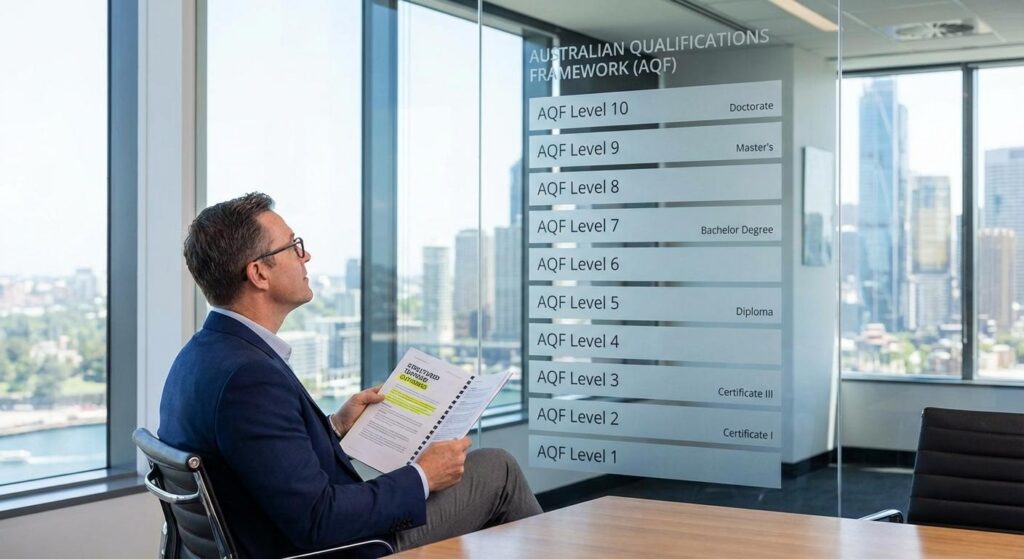
If you work in Australia’s VET sector, you already know that AQF levels are more than just numbers attached to qualifications. They shape how your course is structured, how assessment is written, how validation is conducted, and how auditors interpret compliance.
Yet many RTOs still treat the Australian Qualifications Framework as a reference document instead of a design foundation.
In this guide, we go beyond the basic definition. Yes, we’ll clearly explain AQF levels 1–10. But more importantly, we’ll explore what they actually mean for:
- RTO owners
- Compliance managers
- Instructional designers
- VET trainers
- TAE educators
And how getting AQF alignment right protects your organisation.
What Are AQF Levels?
The Australian Qualifications Framework (AQF) is Australia’s national policy framework for regulated qualifications across schools, vocational education and training (VET), and higher education.
It consists of 10 AQF levels, ranging from Certificate I (Level 1) through to Doctoral Degree (Level 10). Each level reflects increasing:
- Complexity of knowledge
- Depth of skills
- Degree of autonomy
- Application of judgement
- Responsibility in professional contexts
Snippet definition:
AQF levels are the 10 nationally recognised qualification levels in Australia that define the complexity, knowledge depth, skills, autonomy, and volume of learning required for each qualification type.
Each level is described using learning outcomes across three domains:
- Knowledge
- Skills
- Application of knowledge and skills
The framework also defines AQF volume of learning, which refers to the typical full-time duration required to achieve a qualification.
For RTOs, this is not theoretical. AQF descriptors influence:
- Training and assessment strategy (TAS) design
- Assessment complexity
- Validation standards
- Audit outcomes
- Course marketing accuracy
AQF Levels Breakdown (Level 1–10)
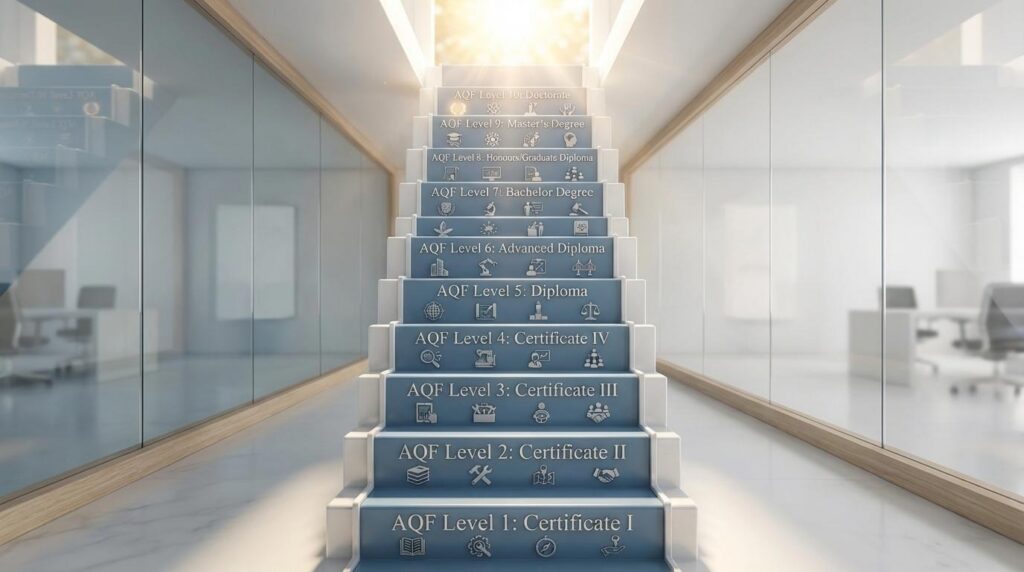
Below is a structured AQF level list to clarify the qualification types within each level.
Levels 1–4: Certificates I–IV (VET Foundation to Skilled Operator)
Sector: VET
Supervision: High → Moderate independence
- Level 1 – Certificate I
Foundational knowledge and basic functional skills. Work is performed under close supervision.
- Level 2 – Certificate II
Basic operational knowledge with limited autonomy.
- Level 3 – Certificate III
Skilled operator level. Application of established procedures and problem solving within known contexts.
- Level 4 – Certificate IV
Broad knowledge base. Greater autonomy, supervisory functions, and problem solving responsibility.
Design implication for RTOs:
Assessment at these levels focuses on demonstration of applied skills in predictable contexts. Overly academic tasks at Certificate I, II or III often trigger compliance risk.
Levels 5–6: Diploma & Advanced Diploma
- Level 5 – Diploma
Technical and theoretical knowledge in a specific area. Application involves planning, judgement, and defined responsibility.
- Level 6 – Advanced Diploma / Associate Degree
Advanced specialised knowledge with substantial judgement and planning responsibility.
This is where many RTOs under-scope assessment complexity. Diploma learners must demonstrate:
- Analytical thinking
- Evaluation
- Independent decision-making
Assessment design must move beyond observation checklists into analysis, scenario-based judgement and structured problem solving.
Level 7: Bachelor Degree
Sector: Higher Education
Level 7 reflects broad and coherent theoretical knowledge. Graduates demonstrate professional practice capability and independent thinking.
AQF Level 7 equivalent searches often refer to:
A Bachelor degree or overseas qualification at comparable academic level.
For international students, this is typically the first full university degree.
Level 8: Honours, Graduate Certificate & Graduate Diploma
Level 8 qualifies graduates for professional work in a specific field and provides a pathway into research or further study.
Level 8 includes:
- Bachelor Honours Degree
- Graduate Certificate
- Graduate Diploma
These qualifications involve advanced theoretical knowledge and specialised application beyond Level 7.
They prepare learners for professional advancement or entry into research pathways.
Level 9: Master’s Degree
Level 9 reflects an advanced body of knowledge applied across a range of contexts. Graduates demonstrate capability for professional practice, research, and scholarship, with a pathway for further learning.
Includes:
- Masters Degree (Coursework)
- Masters Degree (Research)
- Masters Degree (Extended)
This level requires advanced knowledge and high-level analytical skills. Research-based programs demand significant autonomy and scholarly capability.
Level 10: Doctoral Degree
Level 10 qualifications span research and professional doctoral degrees. Graduates apply a substantial body of knowledge to investigate and develop new knowledge, making a significant and original contribution to their field.
Involves:
- Original research
- Knowledge creation
- Full autonomy
- Academic leadership
Doctoral graduates contribute new knowledge to their discipline.
Quick Comparison Table
| AQF Level | Qualification Type | Autonomy | Knowledge Depth |
| 1–4 | Certificate I–IV | Supervised → Independent | Foundational → Broad |
| 5 | Diploma | Independent planning | Technical/theoretical |
| 6 | Advanced Diploma | Substantial judgement | Advanced specialised |
| 7 | Bachelor Degree | Professional autonomy | Broad & coherent |
| 8 | Honours/Grad Cert/Diploma | Advanced application | Specialised |
| 9 | Master’s | High autonomy | Advanced/research |
| 10 | Doctorate | Knowledge creation | Original research |
AQF Levels in the VET Sector (What RTOs Need to Know)
When discussing AQF levels VET, remember:
The VET sector spans Levels 1–8.
This means RTOs delivering Diplomas and Advanced Diplomas must design learning and assessment at significantly higher complexity than Certificate III programs.
Key Differences: Certificate III vs Diploma
Certificate III (Level 3):
- Application of established procedures
- Predictable environments
- Demonstration of competence
Diploma (Level 5):
- Planning and analysis
- Technical and theoretical integration
- Responsibility for others
- Judgement in varied contexts
Many compliance findings arise because:
- Diploma assessments resemble Certificate IV complexity
- Learning outcomes are written below AQF expectations
- Autonomy descriptors are ignored
AQF levels and compliance are directly connected. Misalignment may result in:
- Validation non-conformances
- ASQA audit findings
- TAS weaknesses
Understanding Volume of Learning
One of the most misunderstood areas is AQF volume of learning.
Volume of Learning (VoL) refers to the total time required for a student to achieve competency in a qualification. It encompasses all teaching, learning, and assessment activities, both supervised and unsupervised. The AQF expresses VoL in equivalent full-time years, with one full-time year typically equating to 1,200 hoursWhy This Matters for RTOs
VoL directly informs how training and assessment strategies are designed, documented and justified. Where delivery is accelerated or compressed, RTOs must clearly document the rationale within their Training and Assessment Strategy (TAS), accounting for learner cohort characteristics, mode of delivery, assessment load, and support structures.
This is where instructional design and compliance strategy intersect.
How AQF Levels Affect Course Design and Assessment
This is where theory becomes operational reality. Every level carries specific expectations around knowledge depth, skill application, and learner autonomy that must be reflected in how a course is built and how assessment is written.
The most direct impact is on language.
Learning Outcome Language
At Level 3, verbs may include:
- Apply
- Follow
- Perform
At Level 6, verbs shift to:
- Analyse
- Evaluate
- Develop
- Plan
If the learning outcomes do not reflect the autonomy and complexity required by the AQF level, your course is misaligned.
Assessment Complexity
Assessment must reflect:
- Cognitive demand
- Context variability
- Level of independence
For example:
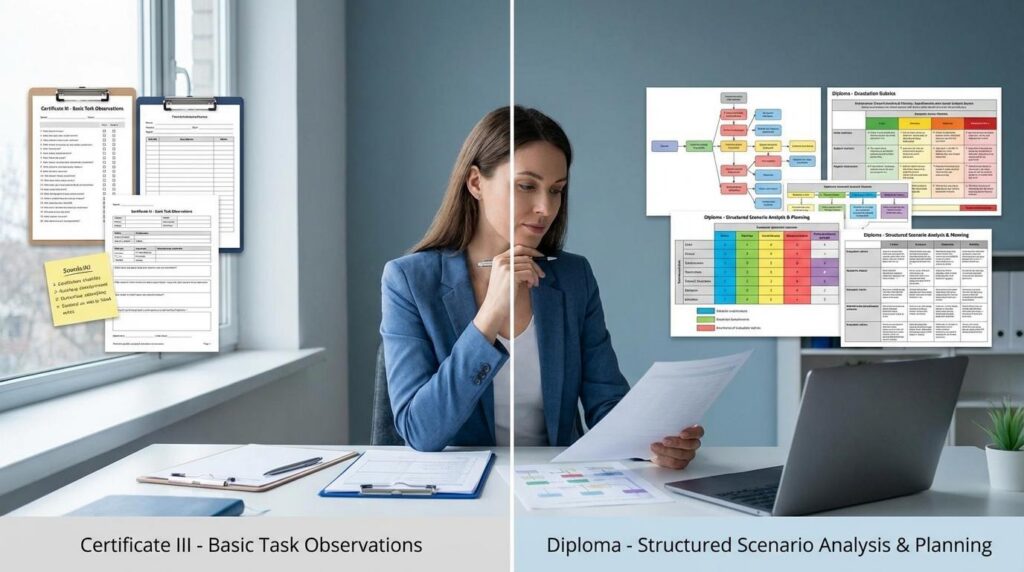
- Certificate II: Direct observation of routine tasks
- Diploma: Scenario-based analysis and justification of decisions
Evidence sufficiency increases with AQF level.
Validation and Compliance Risk
Common triggers include:
- Under-developed Diploma assessments
- Generic marking guides
- Tasks not demonstrating required autonomy
- Over-assessment at lower levels
Strong AQF alignment reduces audit risk and improves learner experience.
Common Mistakes RTOs Make with AQF Levels
1. Confusing Units of Competency with AQF Level
Units define competency standards.
AQF level defines qualification complexity.
They are related but not interchangeable.
2. Under-Scoping Diploma Programs
Diploma programs often lack analytical depth.
If learners are not demonstrating judgement and planning, you are below Level 5 expectations.
3. Over-Assessing Certificate II Learners
Lower-level learners should not be burdened with unnecessary academic analysis.
Assessment should match descriptor expectations.
4. Ignoring Autonomy Descriptors
Autonomy is a defining AQF feature.
Assessment must show increasing independence.
5. Misinterpreting Volume of Learning
Accelerated programs without documented justification are high risk.
AQF Levels and Pathways
AQF supports:
- Credit transfer
- Articulation agreements
- Recognition of Prior Learning (RPL)
- International comparability
For international students, understanding AQF level equivalence supports visa planning and academic progression.
For RTOs, articulation agreements require clear mapping between qualification outcomes.
Frequently Asked Questions About AQF Levels
What is AQF Level 7 equivalent to?
AQF Level 7 is equivalent to a Bachelor Degree. Internationally, it generally aligns with undergraduate degree level study.
Is AQF Level 8 a Doctorate?
No. AQF Level 8 includes Bachelor Honours, Graduate Certificate, and Graduate Diploma qualifications. Doctoral degrees are Level 10.
What is a Level 3 or 4 qualification?
Level 3 is typically Certificate III, reflecting skilled operational work.
Level 4 is Certificate IV, involving broader knowledge and some supervisory responsibility.
How long does each AQF level take?
Duration depends on qualification type and delivery model. The AQF volume of learning provides typical full-time year equivalents.
Can AQF levels be accelerated?
Yes, but only where learning outcomes, assessment sufficiency, and learner characteristics justify the delivery model. Compliance documentation is essential.
How Pop Education Supports AQF-Aligned Course Design

At Pop Education, we work specifically with RTOs, trainers, and compliance teams to ensure programs are not just compliant — but intelligently designed.
Our support includes:
- AQF-aligned assessment development
- Validation and moderation frameworks
- Training and Assessment Strategy reviews
- Professional development for trainers and TAE educators
- Learning resource design aligned to level descriptors
- Compliance advisory support
We don’t simply interpret the framework.
We help you apply it.
If your organisation is:
- Developing resources for a new qualification
- Revising assessments
- Preparing for audit
- Upskilling trainers in learning design
- Reviewing volume of learning justification
Our team can help you strengthen both compliance and educational integrity.
Final Thoughts
Understanding the Australian Qualifications Framework is only the beginning.
For RTOs, the real work lies in:
- Translating descriptors into assessment
- Aligning complexity with learner expectations
- Documenting delivery decisions
- Managing compliance risk
AQF levels are not administrative details, they are the foundation of qualification credibility.
If you want your courses to stand up to audit scrutiny while delivering genuine learner value, alignment must be deliberate.
And that’s exactly what we help you achieve.
If you’d like to review your current programs against AQF expectations, connect with the team at Pop Education to start the conversation.