Vocational Courses in Australia: The Complete 2026 Guide for Students and RTOs
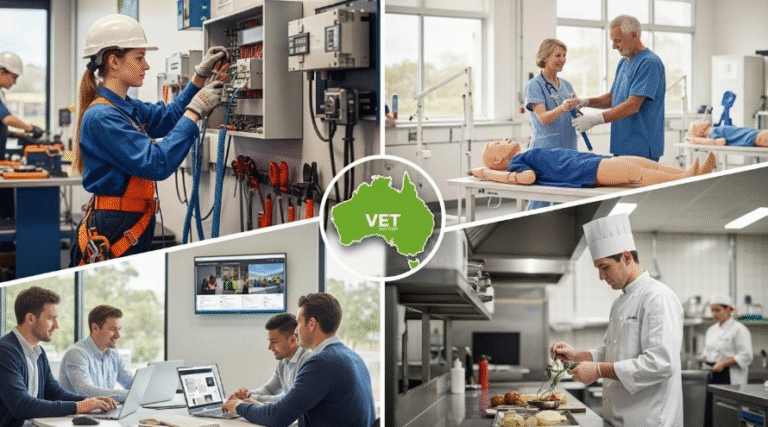
Vocational courses in Australia represent one of the most direct pathways to meaningful employment, practical skills development, and industry-ready careers. Whether you’re a student exploring educational options or a Registered Training Organisation (RTO) looking to deliver high-quality programs that meet both learner needs and compliance standards, understanding how vocational education works in 2026 is essential.
- What Are Vocational Courses in Australia?
- Understanding Australian Qualification Framework (AQF) Levels
- Popular Vocational Study Areas in 2026
- How Vocational Courses Are Delivered in Australia
- Why Compliance Matters in VET Delivery
- How Pop Education Resources Help RTOs Deliver Vocational Courses Successfully
At Pop Education, we work daily with RTOs across Australia, developing compliant and engaging VET (Vocational Education and Training) learning and assessment resources. This guide draws on our hands-on experience in the sector to provide you with a comprehensive understanding of vocational courses—how they function, the career opportunities they create, and how RTOs can deliver them successfully while maintaining quality and compliance.
What Are Vocational Courses in Australia?
Vocational courses are skills-focused qualifications designed to prepare learners for specific jobs and industries through practical, hands-on training rather than purely academic study. Unlike traditional university degrees that emphasise theoretical knowledge, VET courses prioritise workplace readiness, practical application, and competency-based learning aligned with real industry needs.
These courses are delivered through Australia’s nationally regulated VET system by various providers including:
- TAFE institutes – Government-funded vocational education providers across all states and territories
- Private RTOs – Independent training organisations specialising in specific industries or delivery modes
- Dual-sector universities – Institutions offering both higher education and VET qualifications
- Industry training bodies – Sector-specific organisations delivering specialised training
- Enterprise RTOs – Large organisations training their own workforce
The VET system operates under national regulation to ensure consistency, quality, and portability of qualifications across Australia. This means a Certificate III in Commercial Cookery earned in Queensland is recognised and valued in Western Australia, Victoria, or any other state or territory.
In 2026, vocational training continues to thrive precisely because it delivers what Australian employers need most—job-ready graduates who can perform competently from day one, without requiring extensive workplace training to bridge the gap between education and employment.
Why Students Choose Vocational Courses
Based on our experience working with thousands of learners through our RTO partners, combined with insights from industry research and student feedback, students turn to vocational education for five compelling reasons:
- Practical, Hands-On Learning
Vocational courses emphasise doing over memorising. Students learn in workshops, simulations, laboratories or actual workplaces rather than lecture halls. This experiential approach suits learners who prefer active engagement and tangible skill development. When you study automotive technology, you work on real vehicles. When you train in aged care, you practice actual care techniques. This practical focus means graduates enter the workforce already familiar with the tools, processes, and contexts they’ll encounter daily.
- Faster Pathways to Employment
Most vocational qualifications can be completed in months rather than years, getting graduates into paid employment significantly faster than university pathways. A Certificate III might take 6-12 months. Even higher-level Diplomas typically require 12-24 months rather than the 3-4 years common for bachelor degrees. For students eager to start earning or those with financial pressures, this accelerated timeline makes vocational education highly attractive.
- Affordability and Accessibility
VET courses are substantially more cost-effective than university degrees. Government subsidies through programs like Skills First (Victoria), Smart and Skilled (NSW), and similar state initiatives further reduce costs for eligible students. Many RTOs offer flexible payment plans, and some qualifications—particularly apprenticeships and traineeships—allow students to earn while they learn. This financial accessibility opens educational opportunities to learners who might otherwise be excluded.
- Clear Job Outcomes
Every vocational qualification is explicitly tied to real industry roles and career pathways. There’s no ambiguity about what a Certificate III in Early Childhood Education and Care prepares you for—you’ll be qualified to work as an early childhood educator. A Diploma of Building and Construction leads directly to supervisory roles in construction. This clarity helps students make informed decisions and sets clear expectations about employment outcomes.
- Flexible Study Options
Vocational education accommodates diverse life circumstances through multiple delivery modes. Students can choose online self-paced study, blended learning combining digital and face-to-face components, traditional classroom delivery, workplace-based training, or apprenticeship models. This flexibility allows learners to balance work commitments, family responsibilities, and personal circumstances while pursuing qualifications that advance their careers.
In essence, vocational education is built for real people with real career goals, not just school leavers following traditional educational pathways.

Understanding Australian Qualification Framework (AQF) Levels
Vocational courses span six distinct qualification levels within the Australian Qualifications Framework, each building on the previous level with increasing complexity, responsibility, and specialisation:
Certificate I
Entry-level foundational skills for basic participation in work, community, or further learning. These courses introduce fundamental concepts and prepare learners for Certificate II or entry-level employment in supported roles.
Certificate II
Introductory job-specific skills sufficient for basic employment roles. Graduates perform routine tasks under supervision and are prepared for entry-level positions or progression to Certificate III.
Certificate III
Trade-level or job-ready skills qualifying graduates for independent work in their field. This is the qualification level for most Australian apprenticeships and many standalone vocational qualifications. Certificate III graduates can work independently with established routines and procedures.
Certificate IV
Specialist skills or supervisory responsibilities in specific contexts. Examples include TAE40122 (Certificate IV in Training and Assessment), Certificate IV in Project Management Practice, Certificate IV in Cybersecurity, and Certificate IV in Leadership and Management. These qualifications prepare graduates for specialised technical roles or team leadership positions.
Diploma
Advanced technical skills and knowledge for specialised or managerial roles. Diploma graduates typically manage processes, supervise teams, or work in complex technical environments requiring substantial autonomy and judgment.
Advanced Diploma
Higher-level industry expertise and leadership capabilities. Advanced Diploma graduates often fill senior technical roles, manage departments or projects, or work as specialists in complex professional contexts.
This structured framework ensures clear progression pathways—students can start at Certificate II and progressively advance through higher levels as their skills and career goals develop.
Popular Vocational Study Areas in 2026
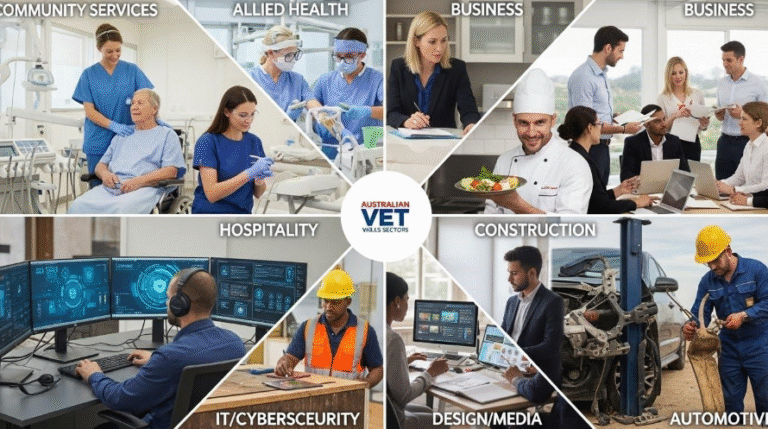
Drawing from national vocational data, industry employment trends, and our direct experience developing resources across multiple sectors, these study areas show particularly strong demand in 2026.
Community Services
Aged care, disability support, mental health, and community development remain growth sectors due to Australia’s aging population and increased focus on inclusive support services. Qualifications in this area lead directly to meaningful, stable employment with clear career progression.
Allied Health Assistance
Nursing support, dental assistance, pharmacy assistance, and therapy support roles continue expanding as healthcare demand increases. These qualifications offer entry into the health sector without requiring university-level study.
Business and Leadership
Administration, project management, leadership, human resources, and business operations qualifications prepare graduates for essential roles across all industries. These portable skills transfer easily between sectors.
Education and Training
Including TAE40122 (Certificate IV in Training and Assessment) and education support qualifications, this sector serves the constant need for qualified trainers, assessors, and educational support staff across RTOs, schools, and workplace training environments.
Hospitality and Tourism
Commercial cookery, hospitality management, events, and tourism operations remain cornerstone industries in Australia’s service economy, particularly as international tourism rebounds post-pandemic.
Construction and Trades
Building, plumbing, electrical, carpentry, and construction management qualifications address ongoing infrastructure demand and housing needs. Skilled tradespeople remain in high demand with excellent income potential.
Information Technology and Cybersecurity
IT networking, cybersecurity, software development, and digital systems qualifications respond to Australia’s digital transformation and growing cyber threats. These technical skills command premium salaries.
Design, Digital Media, and Creative Arts
Graphic design, digital media, photography, and creative industries qualifications serve Australia’s growing creative economy and digital content needs.
Automotive and Engineering Technologies
Vehicle maintenance, engineering trades, and technical operations continue evolving with new technologies like electric vehicles and advanced manufacturing.
These industries experience consistent demand, making vocational qualifications smart pathways into stable careers with genuine employment prospects.

How Vocational Courses Are Delivered in Australia
One of vocational education’s greatest strengths is delivery flexibility. In 2026, RTOs employ various delivery models to meet diverse learner needs:
Face-to-Face Training
Traditional workshops, classrooms, and practical activities remain effective for hands-on skill development, complex practical tasks, and learners who thrive with structured, in-person guidance. Many trades and technical qualifications still rely heavily on face-to-face delivery for practical skill demonstration and practice.
Online Training
Self-paced eLearning, video demonstrations, interactive modules, and digital assessments offer maximum flexibility for theory-based content and knowledge development. Quality online delivery includes interactive elements, multimedia resources, and regular learner support—not just uploaded PDF documents.
Blended Learning
Combining online theory with in-person practical sessions has become the most common delivery model in 2026. Learners complete knowledge components flexibly online, then attend scheduled workshops for hands-on practice, assessment, and face-to-face guidance. This model balances flexibility with practical skill development.
Workplace-Based Training
Training conducted directly in employment environments allows immediate application and authentic assessment in real work contexts. This model suits employed learners and ensures workplace relevance.
Apprenticeships and Traineeships
Structured programs combining paid employment with formal training remain cornerstone pathways in trades and many other industries. Apprentices and trainees earn while they learn, receiving both workplace experience and formal qualifications.
Across all these delivery modes, one requirement never changes: compliance with training package requirements and ASQA standards. This is where many RTOs face challenges—and where Pop Education provides crucial support.

Why Compliance Matters in VET Delivery
Regardless of how creative, flexible, or engaging your training model is, the Australian Skills Quality Authority (ASQA) requires RTOs to demonstrate:
Valid, current, and industry-aligned resources that reflect contemporary workplace practices and meet training package specifications.
Assessment tools that genuinely measure competency according to principles of assessment (validity, reliability, flexibility, fairness) and rules of evidence (validity, sufficiency, authenticity, currency).
Clear mapping to units of competency showing how learning resources and assessment tasks address every performance criteria, knowledge evidence, and performance evidence requirement.
Fair, transparent, and consistent assessment practices ensuring all learners are assessed equitably against the same standards.
Suitable trainers with current qualifications and industry currency maintaining both pedagogical competence (typically TAE40122) and vocational expertise in their training field.
Learning resources accommodating different learning styles to support diverse learners including those with language, literacy, numeracy needs or other learning support requirements.
Assessment conditions matching unit requirements such as access to appropriate equipment, realistic workplace contexts, or simulation environments that accurately reflect industry conditions.
These requirements apply to every delivery mode, including online training. Based on ASQA guidance and our direct experience supporting RTOs through audits, one principle stands out:
“Face-to-face delivery doesn’t always transfer online easily.”
This means RTOs cannot simply upload PDF versions of print materials and call it “online delivery.” Digital resources must be purposefully designed for online engagement, thoroughly mapped to training package requirements, independently validated for compliance, and structured to facilitate genuine learning—not just content consumption.
How RTOs Can Deliver High-Quality Vocational Courses in 2026
From our lived experience working directly with RTOs across Australia—developing their resources, supporting their compliance, and understanding their operational challenges—we’ve identified what successful providers do differently:
- They Start with Strong Learning and Assessment Resources
Well-designed VET resources fundamentally determine both student experience and audit outcomes. Quality resources include clear learning content, varied activities engaging different learning styles, practical tasks building genuine competency, valid assessment tools, and comprehensive mapping documentation. Poor resources create learner frustration, higher attrition, and compliance risk. Excellent resources facilitate effective learning and straightforward compliance demonstration.
- They Design for Multiple Learning Styles
Effective vocational resources incorporate diverse engagement methods. Audio explanations for auditory learners, video demonstrations showing techniques visually, practical tasks building hands-on competence, knowledge checks reinforcing understanding, and interactive elements maintaining engagement. One-dimensional resources (text-only workbooks or lecture-style videos) fail to reach all learners effectively.
- They Create Structured Learning Pathways
The era of “dumping PDFs in an LMS” is over—if it ever truly worked. Students need guided learning journeys with clear progression, regular checkpoints confirming understanding, scaffolded complexity building from foundational to advanced skills, and transparent expectations about what they’ll learn and how they’ll be assessed. Structure reduces learner anxiety and improves completion rates.
- They Maintain Strict Industry Currency
Both trainers and content must reflect current workplace practices. This means trainers engage regularly with industry through employment, professional development, or industry consultation. Resources are reviewed and updated as workplace practices, technologies, regulations, or training packages evolve. Industry currency keeps training relevant and graduates employment ready.
- They Use High-Quality Online Delivery Models
Online learning must be genuinely engaging, properly aligned to training package requirements, and audit ready. Quality online delivery includes interactive modules (not just reading), multimedia explanations, regular learner support and feedback, appropriate assessment conditions, and clear evidence of learning occurring—not just content being accessed.
- They Prepare Evidence for ASQA Continuously
The strongest RTOs don’t “prepare for audits”—they stay compliant year-round. This means maintaining organised validation records, documenting trainer qualifications and currency, keeping assessment records demonstrating consistent application of standards, updating resources as requirements change, and conducting internal audits identifying issues before ASQA does.
Pop Education supports RTOs in all these areas through purpose-built, compliant, and thoughtfully designed resources that make quality delivery achievable.
How Pop Education Resources Help RTOs Deliver Vocational Courses Successfully
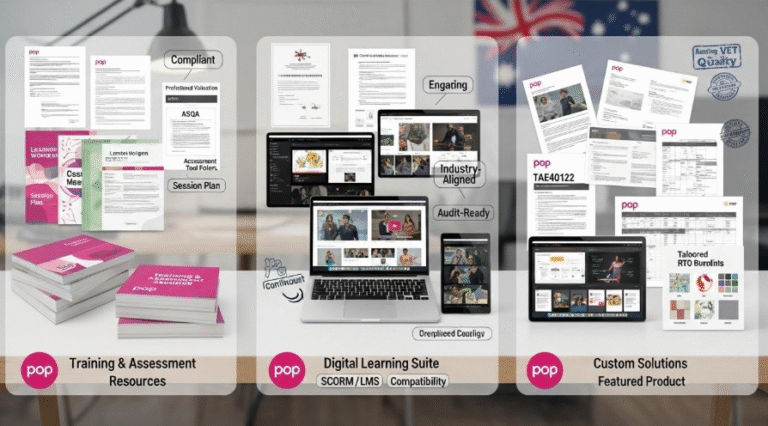
At Pop Education, we specialise in making VET delivery easier, more effective, and more compliant for RTOs across Australia. Our services include:
Training and Assessment Resources for RTOs
Resources for qualifications including: Comprehensive learning content designed for engagement and clarity, validated assessment tools meeting principles and rules, Recognition of Prior Learning (RPL) kits streamlining evidence gathering, detailed session plans supporting effective facilitation, and thorough mapping documents demonstrating training package alignment. Every resource is designed from the ground up for VET compliance.
Digital Learning Design
Modern eLearning development including: Interactive SCORM modules compatible with any LMS, multimedia training experiences incorporating video, audio, and visual elements, gamified learning activities increasing engagement, responsive design working across devices, and progress tracking supporting learner management. We don’t just digitise print materials—we create genuinely digital learning experiences.
Custom Development
Building resources for qualifications from scratch based on an RTO’s specific scope, delivery model, and learner cohort. When off-the-shelf resources don’t fit your context, we develop bespoke solutions addressing your unique requirements while maintaining full compliance.
Resource Upgrades and Compliance Reviews
Fixing audit issues, rebuilding outdated content, and modernising assessments for RTOs needing to address compliance findings, update superseded resources, or enhance quality. We conduct thorough reviews identifying gaps and provide compliant solutions.
Pop bites: Micro-Learning Content
Fast-to-deploy digital learning assets perfect for supplementing existing programs, providing just-in-time training, or enhancing online delivery with engaging, bite-sized content addressing specific skills or knowledge areas.
TAE40122 Expertise
We are recognised leaders in developing resources for Certificate IV in Training and Assessment, the qualification every VET trainer must hold. Our TAE40122 resources include traditional and digital formats, validated assessment tools, simulated RTO environments for authentic practice, and comprehensive support for all core units and popular electives.
Every resource we create is designed to meet:
- Training package requirements with accurate, thorough mapping
- Industry expectations reflecting current workplace practices
- ASQA standards supporting compliance and audit readiness
- Modern learner needs through engaging, accessible design
This combination makes delivery operationally easier and compliance demonstrably stronger—allowing RTOs to focus on teaching rather than administration.
Career Outcomes for Vocational Graduates in 2026
Depending on their chosen field and qualification level, vocational graduates move into diverse employment pathways including:
Trades and apprenticeships – electricians, plumbers, carpenters, builders, mechanics, and other skilled tradespeople earning strong incomes with clear career progression.
Care and support roles – aged care workers, disability support workers, community service professionals, and allied health assistants providing essential services.
IT, cybersecurity, and digital roles – network administrators, cybersecurity analysts, software developers, and digital specialists commanding premium salaries.
Business and administrative roles – project coordinators, business administrators, office managers, and operational staff across all industries.
Community and youth work – youth workers, community development officers, and social support professionals making meaningful differences.
Hospitality and tourism roles – chefs, hospitality managers, event coordinators, and tourism operators in Australia’s vibrant service sector.
Creative and design industries – graphic designers, digital media specialists, photographers, and creative professionals.
Education assistance – teacher aides, education support officers, and learning support professionals in schools and training organisations.
Training and assessment roles – VET trainers, workplace assessors, and learning and development specialists across RTOs and enterprises.
Vocational education represents one of the most direct, reliable pathways to employment in Australia. Unlike some university pathways where graduate employment outcomes are uncertain, VET qualifications are explicitly designed for specific job roles with clear employment destinations.
Why Vocational Courses Matter More Than Ever in 2026
Australia faces significant skills shortages across multiple industries. Demographic shifts create growing demand in aged care and health services. Infrastructure investments require construction and engineering skills. Digital transformation demands IT and cybersecurity expertise. Small business growth needs business administration and management capabilities.
Vocational courses address these needs directly by producing job-ready graduates quickly and efficiently. For learners, this means accessible pathways to stable careers with genuine prospects. For employers, it means access to qualified workers who can contribute immediately. For Australia’s economy, it means a skilled workforce supporting productivity and growth.
For RTOs, the demand for high-quality, compliant delivery has never been higher—particularly as more training moves online and regulatory expectations continue evolving. Success requires not just good intentions but professional resources, robust systems, and genuine commitment to both learner outcomes and compliance standards.
Conclusion: Vocational Education’s Powerful Impact
Vocational courses in Australia give learners practical skills, clear career pathways, and nationally recognised qualifications that employers value and trust. The VET system’s flexibility accommodates diverse life circumstances, its affordability opens opportunities to learners from all backgrounds, and its industry alignment ensures training remains relevant and employment focused.
For RTOs, meeting the growing demand for quality vocational education requires more than just scope registration and good intentions. It demands professionally developed resources, compliance-ready systems, engaging learning experiences, and genuine understanding of what makes VET delivery successful.
Pop Education exists to make this achievable. Through our training and assessment resources, digital learning design, custom development capabilities, and deep expertise in VET compliance, we help RTOs deliver vocational courses that are industry-aligned, learner-focused, audit-ready, and operationally sustainable.
Whether you’re a student choosing your next educational step or an RTO strengthening your delivery capability, vocational training represents one of Australia’s most powerful education pathways. With the right support, resources, and commitment to quality, vocational education continues transforming lives, building careers, and strengthening communities across Australia.
Frequently Asked Questions About Vocational Courses
Q: Are vocational courses recognised across Australia?
Yes, absolutely. VET qualifications are nationally recognised under the Australian Qualifications Framework (AQF), meaning you can study in one state and work anywhere in Australia. A Certificate III in Commercial Cookery from Queensland is recognised and valued in Victoria, Western Australia, or any other state or territory. This national portability gives graduates geographic mobility and employers confidence in qualification standards regardless of where training occurred.
Q: How long do vocational courses take to complete?
Completion time varies significantly by qualification level, study mode, and individual pace. Certificate II and III qualifications typically take 6-12 months. Certificate IV programs usually require 6-18 months depending on complexity and electives chosen. Diploma qualifications generally take 12-24 months, while Advanced Diplomas may require 18-30 months. Full-time study completes faster than part-time, and Recognition of Prior Learning (RPL) can significantly reduce duration for experienced workers. Apprenticeships and traineeships typically span 1-4 years combining employment with structured training.
Q: Can vocational courses be studied online?
Many vocational courses can be studied partially or fully online, particularly theory-based components and knowledge development. However, some qualifications require practical, workplace, or simulated assessments that cannot be completed entirely remotely. For example, Certificate III in Commercial Cookery requires actual food preparation in commercial kitchen environments. Certificate IV in Training and Assessment requires facilitation practice with real learners. Quality RTOs offering online delivery provide interactive digital resources, regular support, and appropriate practical assessment arrangements. Always check with providers about delivery modes and practical requirements before enrolling.
Q: What industries have the highest demand for vocational graduates in 2026?
Based on current employment data and industry trends, these sectors show particularly strong demand: Aged care and disability support (demographic-driven growth), cybersecurity and IT (digital transformation needs), construction and trades (infrastructure investment), hospitality and tourism (post-pandemic recovery), healthcare and allied health (aging population), education support and training (ongoing skills development needs), and business administration (foundational skills needed across all industries). However, demand varies by location, so regional opportunities may differ from metropolitan areas.
Q: How does Pop Education support RTOs?
Pop Education provides comprehensive support including: Complete training and assessment resource packages with learning content, assessment tools, mapping documentation, and validation records; digital learning design creating interactive SCORM modules, multimedia content, and LMS-ready courses; custom development building bespoke qualifications matching specific RTO contexts; compliance reviews and resource upgrades addressing audit findings or updating superseded materials; and specialised expertise in high-demand qualifications like TAE40122. All resources are designed to meet training package requirements, industry expectations, and ASQA standards while being engaging and accessible for modern learners. We help RTOs deliver quality vocational training that is both compliant and effective.