What is Certificate IV in Training and Assessment in 2026? A Complete Guide

In an era where skilled vocational training has never been more crucial, the Certificate IV in Training and Assessment (TAE40122) stands as Australia’s premier qualification for vocational educators. As we move through 2026, this nationally recognised credential remains the gold standard for anyone aspiring to shape Australia’s workforce through quality vocational education.
Whether you’re an experienced tradesperson looking to pass on your expertise, a corporate trainer seeking formal qualifications, or an RTO manager ensuring compliance, Certificate IV in Training and Assessment provides the essential foundation for effective vocational education delivery. This comprehensive guide explores everything you need to know about TAE40122 in 2026 – from course structure and delivery methods to career outcomes and compliance requirements.
Understanding the TAE40122 Qualification
What Exactly is Certificate IV in Training and Assessment?
The Certificate IV in Training and Assessment (TAE40122) is the nationally recognised qualification mandated by the Australian Skills Quality Authority (ASQA) for vocational trainers and assessors. This credential replaced the older TAE40116 version and remains current across all Australian states and territories as we progress through 2026.
This qualification equips graduates with the skills to design, deliver, and assess vocational training within Registered Training Organisations (RTOs), workplaces, community settings, and educational institutions. Importantly, it’s not just about teaching – it’s about ensuring training aligns with the Australian Qualifications Framework and meets national industry standards.
Core Purpose and Industry Recognition
At its heart, Certificate IV in Training and Assessment ensures that vocational educators possess both industry expertise AND pedagogical competence. The qualification bridges the gap between being a subject matter expert and being an effective trainer/assessor who can:
- Develop training that meets specific industry needs
- Assess learner competence accurately and fairly
- Maintain compliance with VET sector requirements
- Adapt training methods to diverse learner groups
- Stay current with evolving educational technologies
The qualification is registered on training.gov.au, Australia’s official national register for vocational education and training, ensuring its recognition by employers, industry bodies, and regulatory authorities nationwide.

Detailed Course Structure and Units
To achieve the Certificate IV in Training and Assessment, candidates must complete 12 units comprising 6 core units and 6 elective units. This structure ensures all graduates meet essential competency standards while allowing specialisation based on individual career paths.
Core Units (Mandatory for All Candidates)
These six units form the foundation of vocational training competence:
- TAEDES411: Use Nationally Recognised Training Products – Teaches educators how to interpret and apply training packages, accredited courses, and units of competency – the building blocks of Australia’s VET system.
- TAEDES412: Design and Develop Plans for Vocational Training – Focuses on creating structured training sessions and programs that meet specific learning outcomes and industry requirements.
- TAEDEL411: Facilitate Vocational Training – Develops practical facilitation skills for delivering engaging, effective training sessions across various delivery modes.
- TAEASS412: Assess Competence – Covers the principles and practices of competency-based assessment, including evidence gathering and decision-making.
- TAEASS413: Participate in Assessment Validation – Teaches the crucial process of quality checking assessment tools and decisions to ensure consistency and compliance.
- TAEPDD401: Work Effectively in the VET Sector Provides understanding of the VET sector‘s regulatory framework, ethical requirements, and professional responsibilities.
Elective Units: Customising Your Qualification
The six elective units allow candidates to specialise based on their intended training context. Popular elective choices in 2026 include:
Digital Delivery Specialisation:
- TAEASS404: Assess Competence in an Online Environment – Essential for RTOs embracing digital assessment.
- TAEDEL405: Plan, Organise and Facilitate Online Learning – Critical for effective virtual training delivery.
- TAEDEL412: Facilitate Workplace-Based Learning – Ideal for on-the-job training. scenarios
Advanced Assessment Skills:
- TAEASS511: Lead Assessment Validation Processes – For those taking quality assurance roles.
- TAEASS502: Design and Develop Assessment Tools – For curriculum developers.
Specialised Training Contexts:
- TAELLN411: Address Adult Language, Literacy and Numeracy Skills – For working with diverse learner groups.
- TAEDEL404: Mentor in the Workplace – For organisational training roles.
This elective flexibility means Certificate IV in Training and Assessment can be tailored to classroom, workplace, online, or blended delivery contexts – a crucial advantage in 2026’s diverse educational landscape.
Who Should Pursue Certificate IV in Training and Assessment?
Target Audience: From Industry Experts to Career Changers
Certificate IV in Training and Assessment serves diverse professionals across multiple sectors:
- Industry Experts and Tradespeople:Experienced professionals with trade qualifications or industryexpertise who want to transition into training roles. This includes electricians, healthcare workers, construction professionals, IT specialists, and hospitality managers seeking to share their knowledge.
- Corporate Trainers and Workplace Assessors:Employees responsible for internal training, onboarding, or skills development within organisations across all industries.
- RTO Professionals:Staff within Registered Training Organisations who need formal qualifications to meet compliance requirements or advance their careers.
- Career Changers and Education Professionals:Teachers from other sectors, retired professionals, or those seeking meaningful second careers in vocational education.
- Small Business Owners and Consultants:Entrepreneurs who provide specialised training services or need to train their own staff effectively.
Entry Requirements and Pathways
To enrol in Certificate IV in Training and Assessment, candidates typically need:
- Vocational Competence: Demonstrable expertise in the field they intend to train/assess, usually through formal qualifications and/or substantial industry experience.
- Language, Literacy and Numeracy (LLN) Skills: Sufficient English proficiency to complete the course requirements and function effectively as a trainer.
- Technology Access: Basic computer skills and reliable internet access, especially for online or blended delivery modes.
RTOs offer Recognition of Prior Learning (RPL) pathways for experienced trainers, potentially reducing study time and cost. Credit transfer arrangements may also apply for those with related qualifications.

Traditional Face-to-Face Delivery
Despite digital advancements, the classroom-based Certificate IV in Training and Assessment remains popular for:
- Hands-on practice with facilitation and assessment techniques
- Immediate feedback from experienced trainers
- Networking opportunities with peers
- Structured learning schedules that suit some learner preferences
Many metropolitan and regional providers offer evening or weekend classes to accommodate working professionals, with typical completion times of 6-12 months.
Blended/Hybrid Learning Models
The most popular approach in 2026 combines online theory with practical workshops. Benefits include:
- Flexibility to study theory components at your own pace
- Practical application during scheduled face-to-face sessions
- Reduced time away from work or family commitments
- Digital skill development alongside training competencies
Blended models typically run over 6-9 months and suit working professionals who value both flexibility and hands-on practice.
Fully Online Delivery
Digital-first Certificate IV in Training and Assessment programs have matured significantly by 2026, offering:
- Complete flexibility for location-independent study
- Digital-first competencies highly relevant to modern training contexts
- Self-paced progression ideal for busy professionals
- Immediate application of online facilitation skills
Quality online programs include virtual workshops, video demonstrations, interactive simulations, and regular facilitator support. Completion typically takes 6-12 months depending on study pace.
Workplace-Based and Traineeship Options
Some organisations partner with RTOs to deliver Certificate IV in Training and Assessment through:
- Formal traineeships combining work and study
- Customised workplace programs tailored to organisational needs
- Mentored pathways with experienced workplace trainers
These options allow immediate application of skills in real training contexts, with assessment often based on workplace activities and evidence.
Career Outcomes and Pathways
Immediate Employment Opportunities
Upon completing Certificate IV in Training and Assessment, graduates qualify for roles including:
- Vocational Trainer/Assessor: Delivering nationally recognised training within RTOs across all industry sectors. With Australia’s ongoing skills shortages, demand remains strong across trades, healthcare, business, technology, and community services.
- Workplace Trainer: Designing and delivering internal training programs within corporations, government departments, not-for-profits, and small businesses.
- Assessment Specialist: Focusing on competency assessment, RPL processes, or quality assurance within RTOs or industry settings.
- Training Coordinator/Designer: Developing training materials, programs, and resources for specific organisational needs.
Salary Expectations and Industry Demand
In 2026, qualified trainers and assessors can expect:
- Entry-level positions: $65,000 – $85,000 annually
- Experienced trainers: $85,000 – $110,000+
- Specialised roles (digital learning, compliance): $90,000 – $120,000
- Consulting/training business owners: Variable, often exceeding $100,000
Industry demand remains robust, with particular growth in digital training delivery, healthcare education, trades training, and corporate upskilling programs.
Further Study Pathways
Certificate IV in Training and Assessment serves as a foundation for advanced qualifications including:
Diploma of Vocational Education and Training (TAE50122): For those seeking leadership roles, advanced instructional design skills or RTO management positions.
Diploma of Training Design and Development (TAE50222): Specialising in curriculum development, learning resource creation and educational design.
Bachelor of Education (Vocational Education & Training): University pathways for those seeking comprehensive pedagogical knowledge and potential school registration.
Specialist Certificates: Short courses in digital learning design, assessment validation, LLN support or specific industry training areas.

Pop Education: Your Partner in TAE40122 Delivery Excellence
Comprehensive Resource Solutions for RTOs
For Registered Training Organisations delivering Certificate IV in Training and Assessment, Pop Education provides turnkey solutions that transform course delivery from administrative burden to strategic advantage.
Professionally Developed, Compliance-Assured Materials
Every Pop Education resource undergoes rigorous development and validation processes:
Dual Validation System:
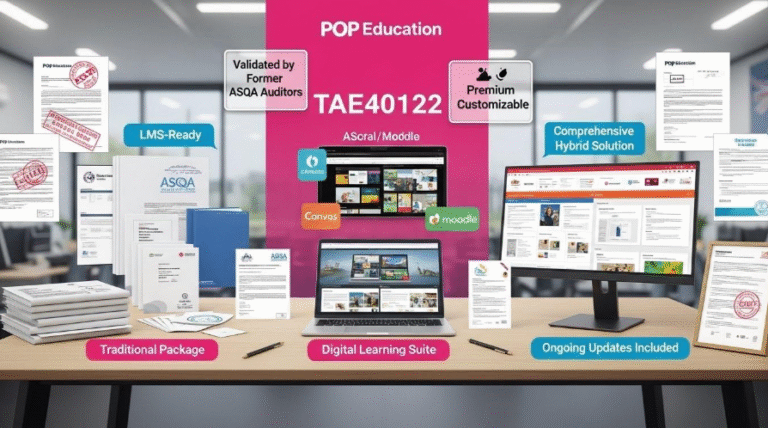
- Stage 1: Traditional assessment tools validated by former ASQA auditors
- Stage 2: Digital adaptations re-validated for online compliance
- Continuous updates reflecting changing standards and best practices
Australian-Based Expertise: All resources developed by TAE-qualified professionals with extensive VET sector experience, ensuring contextual relevance and regulatory alignment.
Flexible Delivery Packages for Modern RTOs
Pop Education offers three comprehensive solutions for Certificate IV in Training and Assessment delivery:
- Traditional Print-Ready Package:
- Complete learner and assessor guides
- Assessment tools and mapping documents
- Session plans and presentation materials
- Ideal for face-to-face or blended delivery contexts
- Digital Learning Suite:
- SCORM-compliant interactive modules
- LMS-ready course shells (Moodle/Canvas compatible)
- Multimedia resources and simulations
- Automated tracking and reporting
- Comprehensive Hybrid Solution:
- Combines traditional and digital resources
- Simulated RTO portal for authentic assessment practice
- Customisable templates and branding options
- Support for all elective combinations
Specialised Support for Digital Competencies
Recognising 2026’s digital-first training landscape, Pop Education includes specialised resources for:
Online Assessment Competence (TAEASS404):
- Digital assessment tools and workflows
- E-portfolio systems and verification processes
- Technology-mediated assessment strategies
Online Facilitation Excellence (TAEDEL405):
- Virtual classroom management techniques
- Engaging digital content creation
- Online learner support strategies
- Technology troubleshooting guides
Compliance and Quality Assurance Advantages
Audit-Ready Documentation
Every resource includes:
- Complete mapping to training package requirements
- Validation records and quality assurance documentation
- Assessment system overviews and procedures
- Candidate evidence guides and templates
Risk Reduction for RTOs
- Eliminates development errors that trigger regulatory non-compliance
- Provides defensible assessment tools and processes
- Maintains current alignment with Standards for RTOs 2025
- Supports continuous improvement through regular updates
Customisation Services
While providing comprehensive ready-to-use resources, Pop Education also offers:
- Brand integration with your RTO’s identity
- Contextual adaptation for specific industry focuses
- Elective customisation based on your delivery model
- LMS integration support for various platforms
Cost-Benefit Analysis for RTOs
Investing in professional Certificate IV in Training and Assessment resources delivers significant returns:
Time Savings:
- Eliminates 200-400+ hours of resource development
- Reduces ongoing maintenance and update workload
- Streamlines audit preparation and compliance management
Quality Enhancement:
- Professional instructional design improves learner outcomes
- Consistent materials ensure training quality across deliveries
- Contemporary resources enhance RTO reputation and appeal
Risk Mitigation:
- Reduces compliance risks and potential regulatory sanctions
- Provides defensible assessment systems
- Supports quality indicator performance (learner and employer satisfaction)
Industry Trends Impacting TAE40122 in 2026
Digital Transformation in Vocational Training
The Certificate IV in Training and Assessment has evolved significantly to address:
AI Integration in Training:
- Using artificial intelligence for personalised learning pathways
- Automated assessment support and feedback systems
- Data analytics for training effectiveness measurement
Immersive Learning Technologies:
- Virtual reality for practical skill simulation
- Augmented reality for workplace-based training enhancement
- Gamification for engagement and skill development
Micro-Credentialing and Badging:
- Stackable credentials within broader qualifications
- Digital badges recognising specific skill achievements
- Portable digital credentials for career mobility
Changing Regulatory Landscape
Certificate IV in Training and Assessment delivery must address:
Enhanced Digital Compliance:
- Data privacy and security requirements for online delivery
- Accessibility standards for diverse learner needs
- International compliance for offshore delivery
Industry 4.0 Integration:
- Training for emerging technologies and work practices
- Cross-sector skill requirements in digital economies
- Sustainability and green skills integration
Workforce Development Priorities
Government and industry initiatives shape Certificate IV in Training and Assessment relevance:
Skills Shortage Response:
- Accelerated pathways for priority industry trainers
- Upskilling programs for existing workforce trainers
- Regional and remote delivery innovations
Lifelong Learning Emphasis:
- Micro-credentials and just-in-time training approaches
- Recognition of informal and workplace learning
- Career transition and reskilling programs
Choosing the Right Provider for Your TAE40122 Journey
For Individual Learners: Selection Criteria
When selecting where to complete your Certificate IV in Training and Assessment, consider:
- Delivery Mode Alignment: Choose providers offering formats that match your learning preferences and lifestyle.
- Industry Connection: Providers with strong industry links offer better practical insights and networking opportunities.
- Digital Competency Focus: Ensure the program adequately covers online facilitation and assessment skills.
- Support Services: Look for comprehensive learner support, including LLN assistance, technology help, and career guidance.
- Cost and Funding Options: Compare fees, payment plans, and government subsidy eligibility.
For RTOs: Partner Selection Factors
When selecting resource providers like Pop Education, RTOs should evaluate:
- Compliance Track Record: Evidence of successful audits and regulatory compliance.
- Update Commitment: Regular review and update processes reflecting changing requirements.
- Customisation Capacity: Ability to tailor resources to your specific context and needs.
- Support Services: Technical support, trainer professional development, and implementation assistance.
- Value Proposition: Total cost of ownership including development time saved and risk reduction.
The Future of Certificate IV in Training and Assessment
Emerging Trends and Adaptations
Looking beyond 2026, Certificate IV in Training and Assessment will likely evolve to address:
AI-Augmented Training Roles:
- Trainers as learning experience curators rather than content deliverers
- Increased focus on human skills (mentoring, coaching, facilitation)
- Technology integration as core competency rather than elective
Global Mobility of Qualifications:
- International recognition and equivalency arrangements
- Cross-border digital delivery standards and quality assurance
- Multicultural and multilingual training competencies
Personalised Learning Pathways:
- Adaptive learning technologies within qualification structures
- Competency-based progression independent of time constraints
- Lifelong learning records integrated with formal qualifications
Continued Relevance in Australia’s Education Ecosystem
Despite technological changes, the core purposes of Certificate IV in Training and Assessment remain constant.
Quality Assurance: Ensuring vocational trainers possess both subject expertise and pedagogical skills.
Standards Maintenance: Upholding the integrity of Australia’s national qualifications framework.
Industry Connection: Bridging workplace requirements with educational delivery.
Learner Protection: Ensuring fair, valid, and reliable assessment practices.
Conclusion: Your Pathway to Vocational Education Excellence
The Certificate IV in Training and Assessment (TAE40122) represents more than just a qualification – it’s your gateway to shaping Australia’s future workforce. As we navigate 2026’s educational landscape, this credential remains indispensable for anyone serious about vocational training excellence.
For individual learners, it opens doors to rewarding careers sharing expertise and developing others’ capabilities. For RTOs, it’s both a compliance requirement and a quality differentiator in competitive training markets. With partners like Pop Education providing comprehensive, compliant resources, delivering Certificate IV in Training and Assessment becomes not just achievable but strategically advantageous.
Whether you’re beginning your training career or enhancing your RTO’s delivery capabilities, now is the time to engage with Certificate IV in Training and Assessment. The skills developed, the compliance assured, and the careers launched through this qualification will continue shaping Australian vocational excellence for years to come.
Certificate IV in Training and Assessment isn’t just about meeting standards – it’s about exceeding expectations, transforming lives through skills development, and contributing to Australia’s economic and social prosperity. In 2026 and beyond, it remains the essential foundation for anyone committed to vocational education excellence.